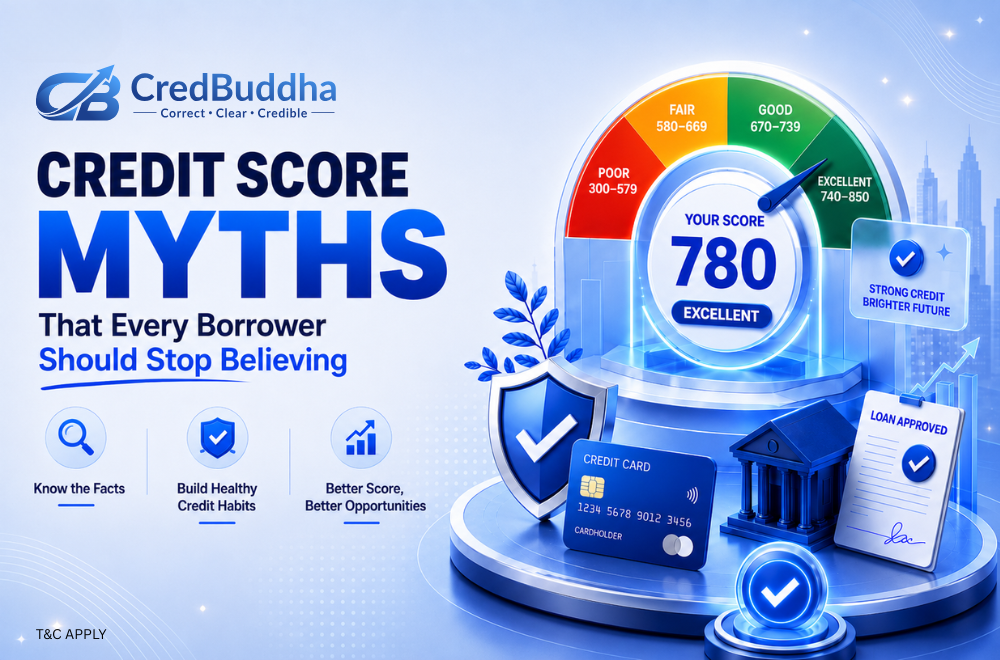
Many borrowers still believe common credit score myths and those mistakes can reduce approval chances for a credit score for a personal loan. On this page, we separate credit score facts from fiction, explain how credit score works and share practical ways to improve credit score with confidence.
What Exactly Is a Credit Score?
A credit score is a three-digit number, usually between 300 and 900, that tells lenders how reliable you are with borrowed money. It's generated by credit bureaus such as TransUnion CIBIL, Experian, Equifax and CRIF High Mark, based entirely on your repayment behaviour over time.
In India, a score of 750 and above is generally seen as good and it can make a real difference to how quickly your loan or credit card gets approved. Lenders use it to decide whether to approve you, how much to lend and at what interest rate. It also matters outside of loans - some landlords and even a few employers, look at it before signing you on.
Take two borrowers with similar salaries. One has a CIBIL score of 780 and gets offered a personal loan at a competitive interest rate. The other with a score of 620, either gets rejected or is offered the loan at a much higher rate. The gap usually comes down to how consistently each of them repaid past dues.
The Real Formula Behind Your Score
Your credit score isn't picked at random - it's built from five factors, each carrying a different weight. Understanding these is the first step to seeing why so many popular beliefs about credit scores simply don't hold up.
| Factor | Approx. Weight | What It Measures |
| Payment History | ~35% | Timely repayment of EMIs and credit card bills |
| Credit Utilisation Ratio | ~30% | How much of your available credit limit you're using |
| Credit History Length | ~15% | How long your oldest active account has been open |
| Credit Mix | ~10% | Balance between secured loans (home, car) and unsecured credit (cards, personal loans) |
| New Credit Enquiries | ~10% | How often you've applied for new credit recently |
Credit Score Myths You Should Stop Believing
This is where we bust the beliefs that quietly cost borrowers money, time and approval chances. For each myth, we'll give you the facts, a short explanation and what to actually do about it.
Myth 1: Checking Your Own Score Brings It Down
Fact: Checking your own credit score never lowers it.
There's a difference between a soft enquiry and a hard enquiry. When you check your own score - say, through CredBuddha's free credit score tool - that's a soft enquiry and it has zero impact on your number. A hard inquiry happens only when a lender pulls your report during a loan or credit card application and even that causes a small, temporary dip at most.
Make it a habit to check your score every few months. It helps you catch errors early, long before you actually need a loan.
Myth 2: A High Salary Means a High Credit Score
Fact: Your income has no direct role in how your credit score is calculated.
Salary decides how much you can borrow and whether you meet a lender's eligibility criteria - not your score. Your score is built purely from how you've handled credit in the past. A high earner who misses EMIs can still end up with a weak score, while a modest earner with a clean repayment record can have an excellent one.
Myth 3: Closing Old Credit Cards Improves Your Score
Fact: Closing an old card can actually pull your score down.
Old cards, even ones you rarely use, add to your credit history length and keep your overall utilisation ratio lower. Shut one down and you might shorten your history and push your utilisation up at the same time - both work against you. Unless a card carries a high annual fee you no longer want to pay, it's usually better to keep old, well-managed accounts open.
Myth 4: Paying the Minimum Due Is Good Enough
Fact: Paying only the minimum due keeps you out of default, but it doesn't protect your score or your wallet.
The unpaid balance continues to attract steep interest charges and your utilisation stays high month after month. Over time, this quietly chips away at your score even though you're technically "not defaulting." Wherever possible, aim to clear the full outstanding amount, not just the minimum.
Myth 5: No Loans Means a Great Score
Fact: No credit history often means no score at all.
If you've never borrowed or used a credit card, bureaus simply don't have enough data to score you - you'll usually see an "NA" or "NH" status instead of a number. Responsible, active use of credit, not the absence of it, is what builds a usable credit file over time.
Myth 6: A Loan Rejection Directly Lowers Your Score
Fact: A rejection itself doesn't hurt your score - but the hard enquiry behind it does.
One rejection alone won't do much damage. The trouble starts when you apply to multiple lenders back-to-back after a rejection, since each application triggers a fresh hard enquiry and these add up quickly in a short span.
Myth 7: Settling a Loan Is the Same as Closing It
Fact: A loan marked "settled" is treated very differently from one marked "closed," and it can affect your score for years.
A settled status means you paid less than what was owed and lenders read this as a sign of past financial strain. Wherever you can manage it, negotiating to repay the full amount and get a "closed" status is far better for your long-term credit health than settling for less.
Myth 8: Your Score Can Improve Overnight
Fact: Credit scores improve gradually, not instantly.
There's no quick fix here. With consistent good habits - on-time payments, low utilisation - you'll typically start seeing visible movement over three to six months. Anyone promising an overnight fix isn't giving you the full picture.
Myth 9: Every Lender Follows the Same Approval Rules
Fact: Each bank or NBFC applies its own internal risk criteria on top of your credit score.
The same score can get you approved at one lender and rejected at another. This is exactly why comparing offers across multiple lenders, rather than relying on just one, gives you a much better shot at approval.
Myth 10: Small Loans Don't Need a Good Score
Fact: Most lenders, including BNPL apps and small-ticket loan providers, check your credit history regardless of the loan size.
Even a modest loan application usually triggers a credit check. Treating small borrowings casually can still leave a mark on your report.
Myth 11: You Only Have One Credit Score
Fact: CIBIL, Experian, Equifax and CRIF High Mark each run their own scoring models, so your score can vary slightly between them.
This is why a lender pulling your Experian report might show a slightly different number than your CIBIL score. The underlying credit behaviour is what stays consistent - it's just the scoring model that differs. It's a good idea to check your report from more than one bureau occasionally.
Myth 12: UPI and Debit Card Spending Affects Your Score
Fact: Debit card, UPI and savings account activity are never reported to credit bureaus.
Only borrowed credit - loans and credit cards - gets tracked. This is an important one to remember in a country where most daily spending happens through UPI. Spending your own money and borrowing money are two entirely separate things as far as your credit score is concerned.
Myth 13: BNPL and Small Digital Loans Don't Affect Your Score
Fact: A growing number of Buy Now Pay Later and short-tenure digital lending apps now report directly to credit bureaus.
Missed repayments on these can hurt your score just like a missed credit card payment would. With BNPL adoption rising fast among young professionals and first-time borrowers, it's worth treating these the same way you'd treat a bank loan or credit card.
Myth 14: Being a Guarantor Doesn't Touch Your Own Score
Fact: As a guarantor or co-applicant, the loan shows up on your credit report too.
If the primary borrower defaults, it's your score that takes the hit, not just theirs. Think this through carefully before agreeing to guarantee a loan for a friend or family member.
What These Myths Actually Cost You
Believing even one or two of these myths can quietly work against your finances. Here's what's typically at stake:
Loan rejections that could have been avoided
Higher interest rates on approved loans
Lower loan eligibility than you actually deserve
Credit card applications getting turned down
Delays to bigger goals like buying a home, funding education or expanding a business
Habits That Genuinely Build a Better Score
Once the myths are out of the way, improving your score comes down to a fairly simple set of habits, repeated consistently:
Pay your EMIs on time, every time
Pay credit card bills in full, not just the minimum due
Keep your credit utilisation below 30% of your limit
Avoid applying for multiple loans or cards in a short window
Keep older, well-managed credit accounts open
Review your credit report regularly for accuracy
Get any errors on your report corrected promptly
Understanding Where Your Score Stands
Once you know your score, it helps to know what it actually means in practical terms. Here's a general guide used across Indian lending:
| Credit Score | Rating | Loan Approval Chances |
| 750–900 | Excellent | Very High |
| 700–749 | Good | High |
| 650–699 | Fair | Moderate |
| 600–649 | Poor | Low |
| Below 600 | Very Poor | Difficult |
Mistakes That Quietly Damage Your Score
Beyond the myths, there are everyday habits that directly hurt your credit score:
Missing EMI payments, even occasionally
Maxing out credit cards regularly
Ignoring your credit report for years at a stretch
Applying for several loans or cards within a short period
Settling loans instead of repaying them in full
Agreeing to be a guarantor without fully understanding the risk involved
Checking Your Credit Score the Right Way
Checking your score is straightforward once you know the steps to follow:
Visit an authorised credit bureau or an RBI-regulated financial platform, such as CredBuddha's free credit score tool
Complete identity verification using your PAN or Aadhaar details
Download your full credit report
Go through your credit history line by line
Raise a dispute directly with the bureau for any incorrect entries
How Your Score Shapes Your Personal Loan
Your credit score has a direct say in your personal loan journey - it influences your interest rate, your eligibility, how quickly you're approved and the loan amount a lender is willing to offer. A strong score, typically 750 and above, often unlocks pre-approved offers and faster, near-instant disbursal.
| Factor | Borrower with 700 Score | Borrower with 800 Score |
| Interest Rate | Higher | Lower |
| Eligibility | Moderate | High |
| Approval Speed | Standard processing | Faster, often near-instant |
| Loan Amount Offered | Lower | Higher |
Since different lenders apply different internal cut-offs, as we saw in Myth 9, you're not limited to what a single bank or NBFC is willing to offer you.
How CredBuddha Makes This Easier
At CredBuddha, we built our platform around exactly this problem - helping you make sense of your credit score and find a loan that actually fits your profile without the guesswork.
On our page, you can compare personal loan offers from 20+ verified lending partners, check your eligibility instantly and access your credit score for free, along with simple educational resources to help you understand it better. Our EMI calculator and personal loan EMI calculator make it easy to plan repayments before you commit and our financial planning resources are designed to support responsible borrowing at every step.
Every comparison on our platform stays transparent and RBI-compliant, so you can make an informed decision rather than relying on assumptions - or myths - about what your credit score really means.
Stop Believing Credit Score Myths - Build Better Credit
Falling for credit score myths can end up costing you real money - through a rejected loan application, a higher interest rate or lower eligibility than you actually deserve. The better approach is to stick to credit score facts, understand how credit score works and build good credit habits that hold up over time. Paying your EMIs on schedule, keeping credit utilisation low, checking your credit report regularly and knowing the difference between a soft enquiry and a hard enquiry all go a long way in helping you improve your credit score and strengthen your personal loan credit score. At the end of the day, CIBIL score myths and credit report myths shouldn't be what guides your financial decisions - accurate information and responsible borrowing should.
Key Takeaways
Check your credit score regularly - a soft enquiry never brings your score down.
Spot and fix errors in your credit report early, rather than discovering them right when you apply for a loan.
Treat credit cards, BNPL and digital loans with the same discipline, since all of them shape your credit history.
Follow RBI's responsible borrowing guidance and stay consistent with your habits to maintain a good credit score.
Don't let credit score myths hold you back from achieving your financial goals. Learn the facts, improve your credit profile and compare the best personal loan offers from trusted banks and NBFCs with CredBuddha. Make smarter borrowing decisions with confidence and transparency.
FAQ
1.Does checking my own credit score reduce it?
No. Checking your own score is a soft enquiry and does not affect it. You can check your credit-related guides on the CredBuddha website.
2.What is considered a good CIBIL score?
A CIBIL score of 750 or above is generally considered good for most loans. Visit CredBuddha to understand eligibility and compare lenders.
3.Does a high salary guarantee loan approval?
No. Lenders also review your credit history, repayment behaviour and existing debts. You can learn more on the CredBuddha website.
4.Does closing a credit card improve my score?
Not always. Closing an old card may increase your credit utilisation ratio. Check our Credit Score Guide on CredBuddha for more details.
5.How long does it take to improve a credit score?
It usually takes a few months of timely repayments and responsible credit use. Visit CredBuddha for practical credit improvement tips.
6.Does loan rejection affect my CIBIL score?
A rejection itself doesn't, but multiple hard enquiries may impact your score. You can compare suitable loan options on CredBuddha before applying.
7.Is loan settlement bad for my credit score?
Yes. A settled loan can negatively affect future borrowing. Visit CredBuddha to understand better repayment and loan management options.
8.What is the ideal credit utilization ratio?
Keeping your credit utilisation below 30% is generally recommended. You can explore more credit score tips on the CredBuddha website.
9.How often should I check my credit score?
Reviewing your score every 3-6 months helps you catch errors early. Visit CredBuddha for credit monitoring and financial planning resources.
10.How can I improve my credit score before applying for a loan?
Pay EMIs on time, keep balances low and avoid unnecessary enquiries. Compare the best personal loan offers and eligibility on CredBuddha before applying.

Jul 03, 2026

Jul 02, 2026
Fast • Secure • Free
By continuing, you agree to our Terms & Privacy Policy.